Supercharging Linux Paging: How bpf_fault Rewrites Memory Management
What if operating system page fault handling didn't require massive performance penalties or context-switching overhead? How bpf_fault—winner of both the Best Paper and Distinguished Artifact awards at SOSP 2026—brings user-defined, in-kernel extensibility directly to Linux virtual memory.
This week in the Garden Dispatch, we examine: Supercharging Linux Paging: How bpf_fault Rewrites Memory Management.
Let's dive in.
November 2026 — Linux Kernel Architecture & eBPF Virtual Memory Extensibility
What if operating system page fault handling didn't require massive performance penalties or context-switching overhead? Discover how bpf_fault—winner of both the Best Paper and Distinguished Artifact awards at SOSP 2026—brings user-defined, in-kernel extensibility directly to Linux virtual memory!
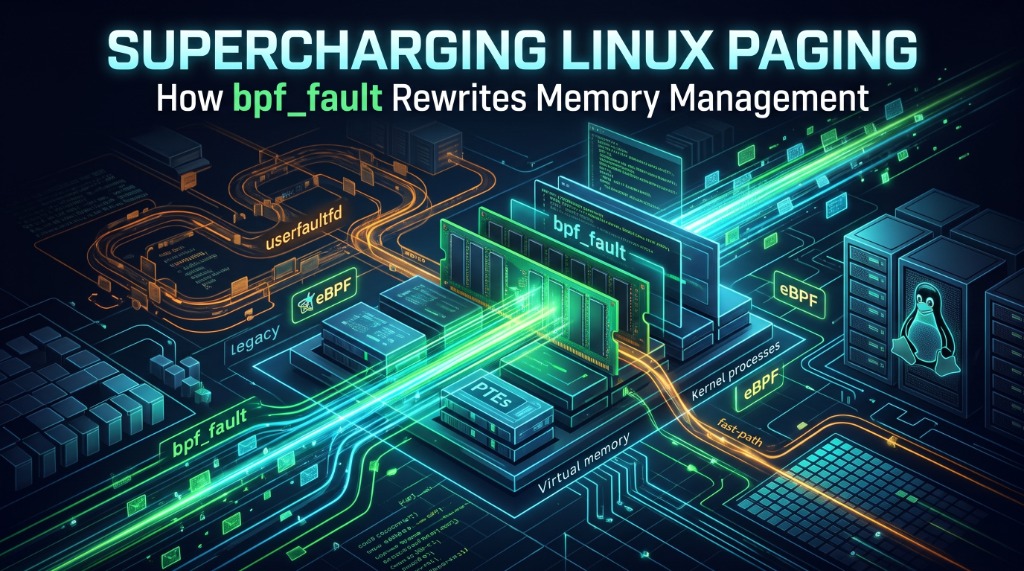
The Bottleneck: Why Traditional Page Faulting Slows Down Modern Apps
High-performance applications like virtual machine hypervisors (QEMU, Firecracker), garbage-collected language runtimes (OpenJDK, MMTk), and memory debuggers constantly need to intercept virtual memory page faults. Historically, Linux provided two main tools for this—both coming with hefty performance trade-offs:
1. POSIX Signals (SIGSEGV)
Requires registering a process-wide signal handler. Because signals are global to the process, independent libraries cannot isolate their own fault handlers without colliding. Every single page fault triggers:
- Kernel-to-user signal frame setup
- Thread stack switch
- rt_sigreturn syscall teardown2. userfaultfd (uffd)
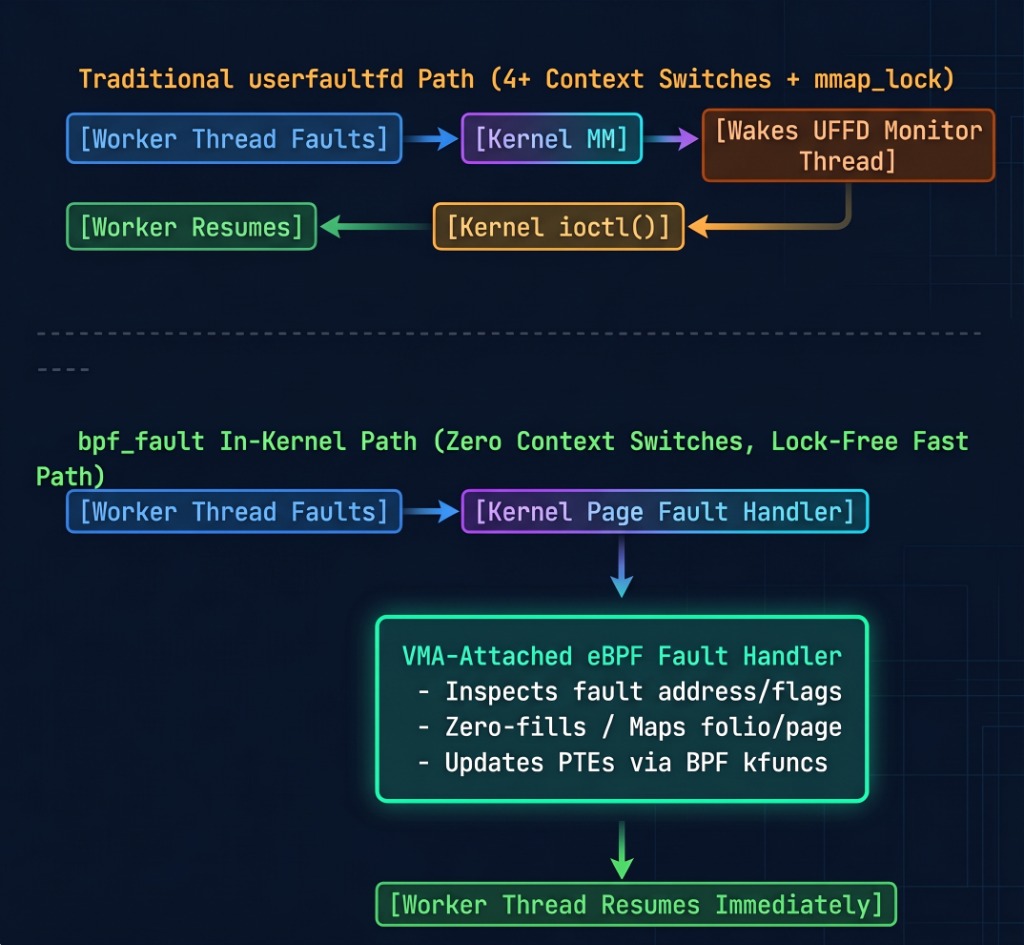
Exposes a file descriptor that streams page fault events to a dedicated userspace monitor thread. While safer than SIGSEGV, userfaultfd suffers from three systemic bottlenecks:- ◆Cross-Thread Context Switching: A faulting worker thread must block in the kernel while the fault message is queued, wakes up a separate handler thread in userspace, processes the page, and issues an
ioctl()(UFFDIO_COPY/UFFDIO_ZEROPAGE) back into the kernel. - ◆
mmap_lockContention: Resolving faults viauserfaultfdioctlpaths frequently acquires the per-processmmap_lock, serializing concurrent page faults across multi-core workloads. - ◆Library Composability Failure: Because
userfaultfdbinds at the Virtual Memory Area (VMA) or address-space level with centralized monitor loops, third-party libraries (e.g., custom allocators or dynamic linkers) cannot transparently register isolated fault handlers without coordinating with the host application.
Enter bpf_fault: In-Kernel Extensibility for Virtual Memory
Instead of bouncing back and forth between kernelspace and userspace, bpf_fault lets developers attach verified eBPF bytecode directly to specific Virtual Memory Areas (VMAs). The fault handling logic executes instantly right inside the kernel!
Core Architectural Pillars
- ◆Per-VMA Scoped Attachment: Unlike process-global
SIGSEGVhandlers,bpf_faultattaches eBPF programs to individual VMAs (viamadvise/prctl/bpf()link primitives). Multiple independent libraries within the same process can register distinct fault handlers on their own memory mappings without interference. - ◆Synchronous In-Context Execution: When a thread triggers a minor, major, or write-protect fault within a
bpf_fault-managed VMA, the kernel'shandle_mm_fault()invokes the attached eBPF bytecode synchronously within the faulting thread's kernel context—eliminating monitor threads, ring-buffer wakeups, andioctlsyscalls. - ◆Safe Page Table Manipulation via Kernel Functions (
kfuncs): To maintain kernel memory safety, the eBPF verifier enforces strict bounds and lifetime checks while exposing dedicatedbpf_faultkfuncsthat allow the eBPF program to: - ◆- Allocate and zero-fill folios/pages (
bpf_fault_zeropage). - ◆- Copy or decompress data from BPF maps or pre-registered buffers into newly mapped pages (
bpf_fault_copy). - ◆- Modify Page Table Entry (PTE) permissions (e.g., toggling read-only write-protect bits for dirty-page tracking).
- ◆- Defer complex faults to a traditional userspace fallback path if resolution requires network I/O (such as fetching a remote page during post-copy migration).
Real-World Superpowers Evaluated at SOSP '26
The bpf_fault framework was evaluated across diverse production workloads, demonstrating dramatic latency reductions and multi-core scalability improvements:
- ◆Hypervisor Live Snapshots (Firecracker & QEMU): During lazy snapshot restoration or background dirty-page tracking,
bpf_faulthandles missing or write-protected guest physical pages directly inside the kernel using pre-populated BPF maps or zero-pagekfuncs, avoiding VM-exit stalls caused by userspaceuffdthread contention. - ◆Concurrent Garbage Collection (MMTk / OpenJDK): Modern concurrent collectors rely on page-protection barriers to track object mutations and evacuate heap regions. Replacing
SIGSEGVanduserfaultfdbarriers withbpf_faulteliminates signal-delivery overhead during mutator threads' heap writes. - ◆Deferred Dynamic Linking (
bpf-dynlinkinglibc): Standard dynamic linkers resolve thousands of ELF relative relocations upfront at process startup, penalizing cold-start latency. Usingbpf_fault, relocations are deferred on a per-page basis and patched lazily in-kernel on first page access without requiring changes to the host binary. - ◆Guard-Page Memory Debugging (
ebpfency): High-overhead Electric Fence allocators isolate heap allocations on separate pages to catch out-of-bounds accesses.bpf_faultreduces per-allocationmmap/mprotectfault overhead by orders of magnitude.
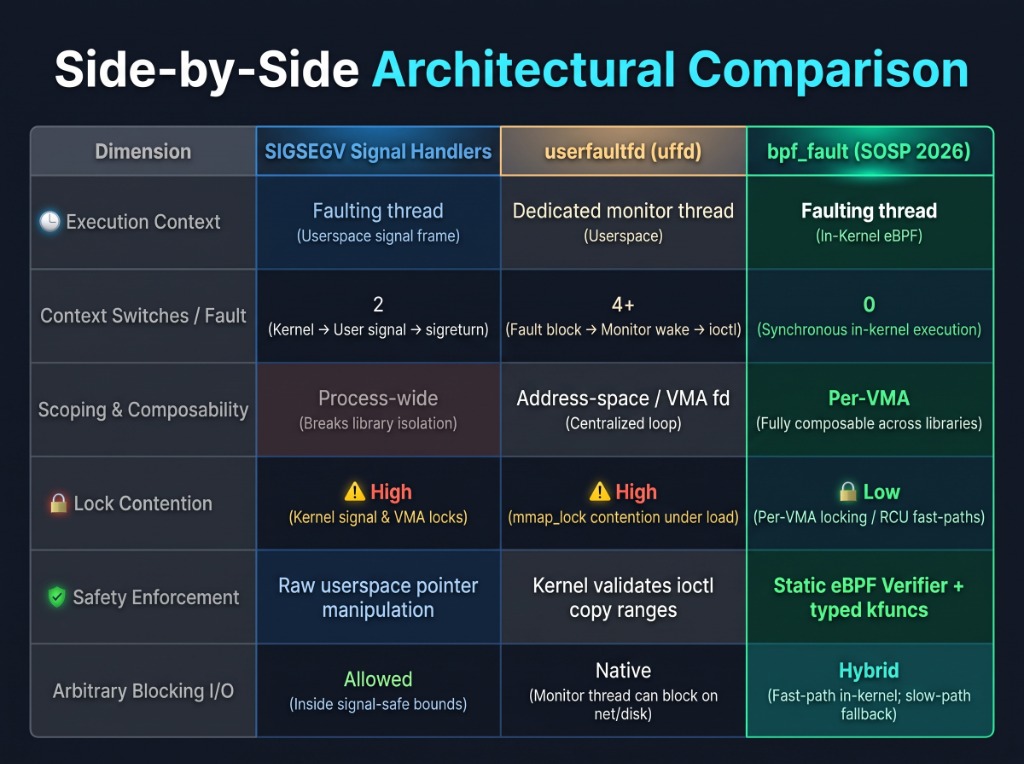
Architectural Telemetry & Benchmark Comparison
| Dimension | SIGSEGV Signal Handlers | userfaultfd (uffd) | bpf_fault (SOSP 2026) |
|---|---|---|---|
| Execution Context | Faulting thread (Userspace signal frame) | Dedicated monitor thread (Userspace) | Faulting thread (In-Kernel eBPF) |
| Context Switches / Fault | 2 (Kernel → User signal → sigreturn) | 4+ (Fault block → Monitor wake → ioctl) | 0 (Synchronous in-kernel execution) |
| Scoping & Composability | Process-wide (Breaks library isolation) | Address-space / VMA fd (Centralized loop) | Per-VMA (Fully composable across libraries) |
| Lock Contention | ⚠️ High (Kernel signal & VMA locks) | ⚠️ High (mmap_lock contention under load) | 🔒 Low (Per-VMA locking / RCU fast-paths) |
| Safety Enforcement | Raw userspace pointer manipulation | Kernel validates ioctl copy ranges | Static eBPF Verifier + typed kfuncs |
| Arbitrary Blocking I/O | Allowed (Inside signal-safe bounds) | Native (Monitor thread can block on net/disk) | Hybrid (Fast-path in-kernel; slow-path fallback) |
The Future of Kernel Architecture
1. The Kernel-Extensibility Paradigm Shift
Followingsched_ext (eBPF CPU scheduling) and cache_ext (eBPF page cache eviction policies), bpf_fault extends programmable kernel customization into the virtual memory fault path—turning rigid OS paging policies into safe, application-specific kernel plugins.2. Eliminating the Userspace-Kernel Ping-Pong
As core counts scale past 128+ threads per socket, centralized userspace monitor threads (userfaultfd) become acute serialization bottlenecks. Pushing policy execution back into verified eBPF hooks restores linear multi-core scalability.