Daily Tech Research: Multi-GPU Interconnect Side Channels (NVBleed)
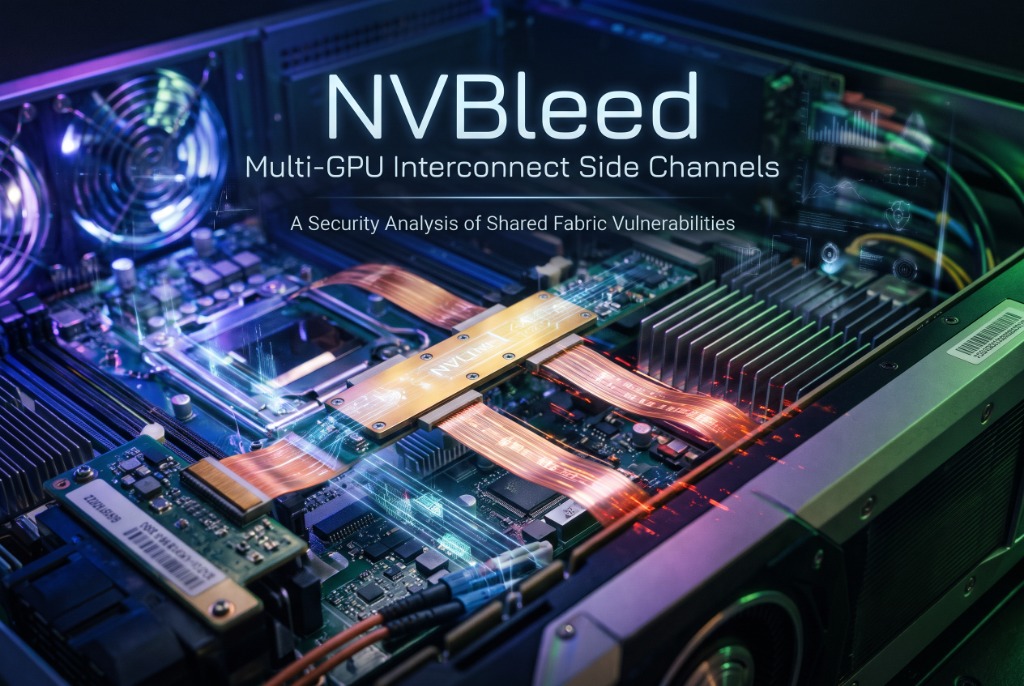
How NVBleed (ACM CCS 2026) exploits NVIDIA NVLink and NVSwitch fabrics via unprivileged telemetry counters (LeakyCounterLink) and peer-to-peer link contention (ContenLink) to fingerprint AI workloads and cross-VM cloud rendering.
This week in the Garden Dispatch, we examine: Daily Tech Research: Multi-GPU Interconnect Side Channels (NVBleed).
Let's dive in.
November 2026 — Multi-GPU Interconnect Architecture & Cloud Isolation Boundaries
Today's research examines multi-GPU system interconnects and cloud isolation boundaries: NVBleed: Covert and Side-Channel Attacks on NVIDIA Multi-GPU Interconnect, presented at ACM CCS 2026 by researchers from UC Riverside and Brookhaven National Laboratory.
The Core Problem: Shared Interconnect Fabrics in Multi-GPU Nodes
Modern cloud instances and high-performance computing (HPC) nodes—such as NVIDIA DGX systems and multi-GPU cloud virtual machines—interconnect multiple GPUs via high-bandwidth, point-to-point NVLink and NVSwitch fabrics to bypass PCIe Gen 4/5 throughput bottlenecks.
While PCIe bus contention and single-GPU shared-memory/cache side channels have been studied extensively, multi-GPU interconnects were largely treated as isolated, high-speed data pipes. However, two architectural design choices expose NVLink fabrics to cross-process and cross-VM telemetry leakage:
- ◆Unprivileged Hardware Telemetry Counters: NVIDIA's profiling interfaces (such as CUPTI metrics and NVLink hardware counters) expose granular traffic statistics—including packet transmission counts, receive byte volume, and link utilization—that are frequently readable without administrative privileges on multi-tenant nodes.
- ◆Physical Link Contention: Even when hardware performance counters are restricted at the hypervisor or driver level, concurrent peer-to-peer memory transfers (
cudaMemcpyPeeror Unified Memory page migrations) traverse shared physical NVLink lanes and switch arbiters, creating deterministic queueing delays.
1. Reverse-Engineering NVLink Leakage Primitives
Researchers characterized two distinct leakage vectors across multi-GPU topologies (both direct NVLink bridges and NVSwitch-routed fabrics):
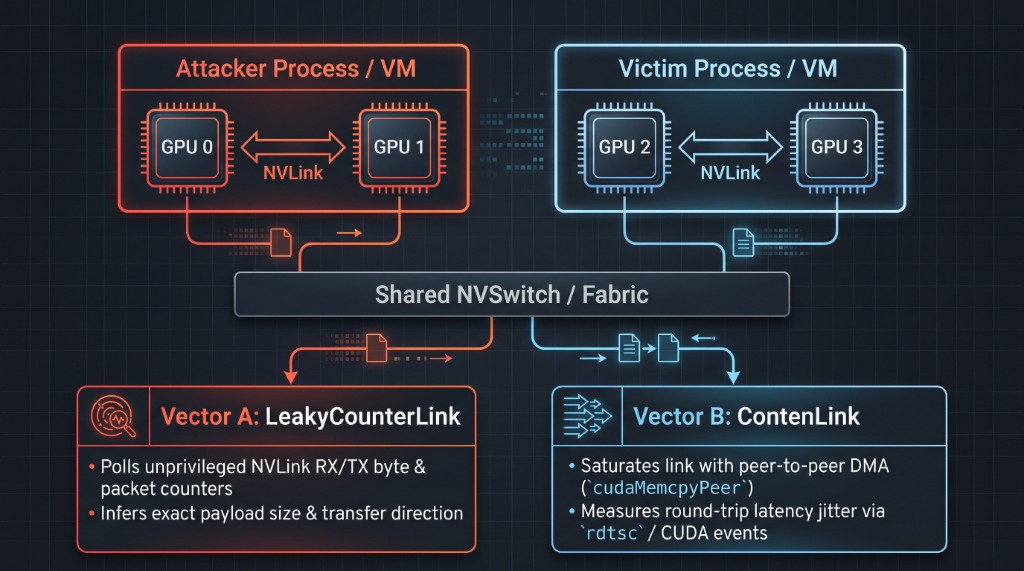
- ◆Directional & Volumetric Fingerprinting (
LeakyCounterLink): By sampling NVLink transmit (nvlink_transmit_throughput) and receive (nvlink_receive_throughput) counters at sub-millisecond intervals, an unprivileged observer can reconstruct the exact transfer sizes, burst cadence, and directional topology (e.g., all-reduce ring patterns vs. point-to-point tensor sharding) of co-located workloads. - ◆Contention-Based Timing (
ContenLink): When an attacker continuously issues small peer-to-peer memory copies across a shared NVLink path, victim DMA bursts saturate link buffers and credit pools. Measuring transfer latency via high-resolution CPU timers (rdtsc) or GPU clock registers (globaltimer) reveals when and how much data the victim transmits—requiring zero access to hardware performance counters.
2. Covert Channels & Cross-VM Side-Channel Exploitation
Using these two primitives, the researchers demonstrated both high-speed covert data exfiltration and cross-tenant application fingerprinting:
Intra-Node GPU-to-GPU Covert Channels
- ◆ContenLink: A sender process on one GPU modulates NVLink bandwidth utilization (sending large buffers for
1, idling for0), while a receiver on a paired GPU measures transfer latency spikes. - ◆LeakyCounterLink: Achieves significantly higher bandwidth and lower bit-error rates by encoding multi-bit symbols into specific NVLink packet sizes that the receiver reads directly from link telemetry counters.
Workload & ML Architecture Fingerprinting
- ◆Across 18 distinct HPC and deep learning workloads (including distributed PyTorch training, molecular dynamics, and graph analytics), statistical features extracted from NVLink traces allowed standard classifiers (XGBoost, LightGBM) to identify the victim's exact workload with over 97% F1-score.
Cross-VM Side-Channel on Public Cloud (GCP)
- ◆On virtualized multi-GPU cloud instances (evaluated on Google Cloud Platform) where separate VMs shared underlying NVLink interconnects, an attacker VM passively monitored interconnect contention while a victim VM rendered 3D scenes in Blender.
- ◆Because distinct 3D models and geometry meshes generate unique frame-buffer and texture synchronization traffic across GPUs, the attacker identified which 3D character model the victim was rendering with an F1-score exceeding 88%.
Key Takeaways & Systems Engineering Trajectory
- ◆Interconnects as a First-Class Attack Surface: As distributed AI training and multi-GPU rendering scale horizontally, high-speed fabrics (NVLink, AMD Infinity Fabric, UALink) carry rich structural metadata—such as tensor parallelism boundaries, all-reduce synchronization barriers, and model layer sizes—that leak through physical contention even when HBM memory is strictly isolated.
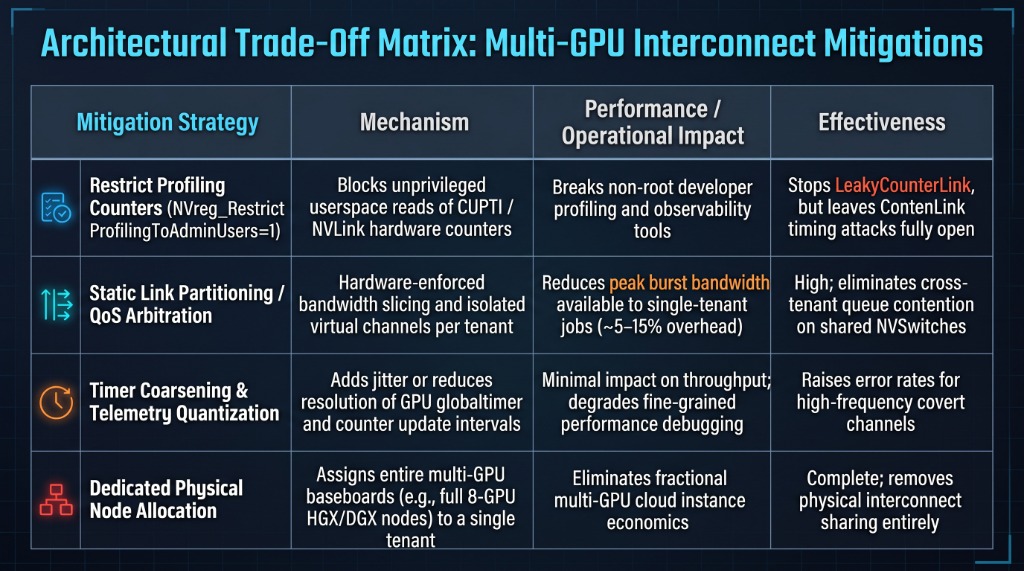
- ◆Telemetry vs. Isolation Tension: Cloud providers face an inherent trade-off between exposing low-level hardware performance counters for ML workload optimization and preventing unprivileged side-channel reconnaissance.
- ◆Hardware Quality-of-Service (QoS) Requirements: Just as CPU architectures adopted Cache Allocation Technology (CAT) and memory bandwidth partitioning to defend against L3/DRAM side channels, next-generation GPU fabrics require hardware-enforced link scheduling and deterministic credit isolation between virtualized GPU partitions (MIG / SR-IOV).