Shakespeare Programming Language: Where Code Takes Center Stage
What if software logic was written as dramatic dialogue? Discover how SPL transforms variables into tragic heroes and control flow into theatrical stage directions.
This week in the Garden Dispatch, we examine: Shakespeare Programming Language: Where Code Takes Center Stage.
Let's dive in.
November 2026 — Programming Language Design & Esoteric Computation
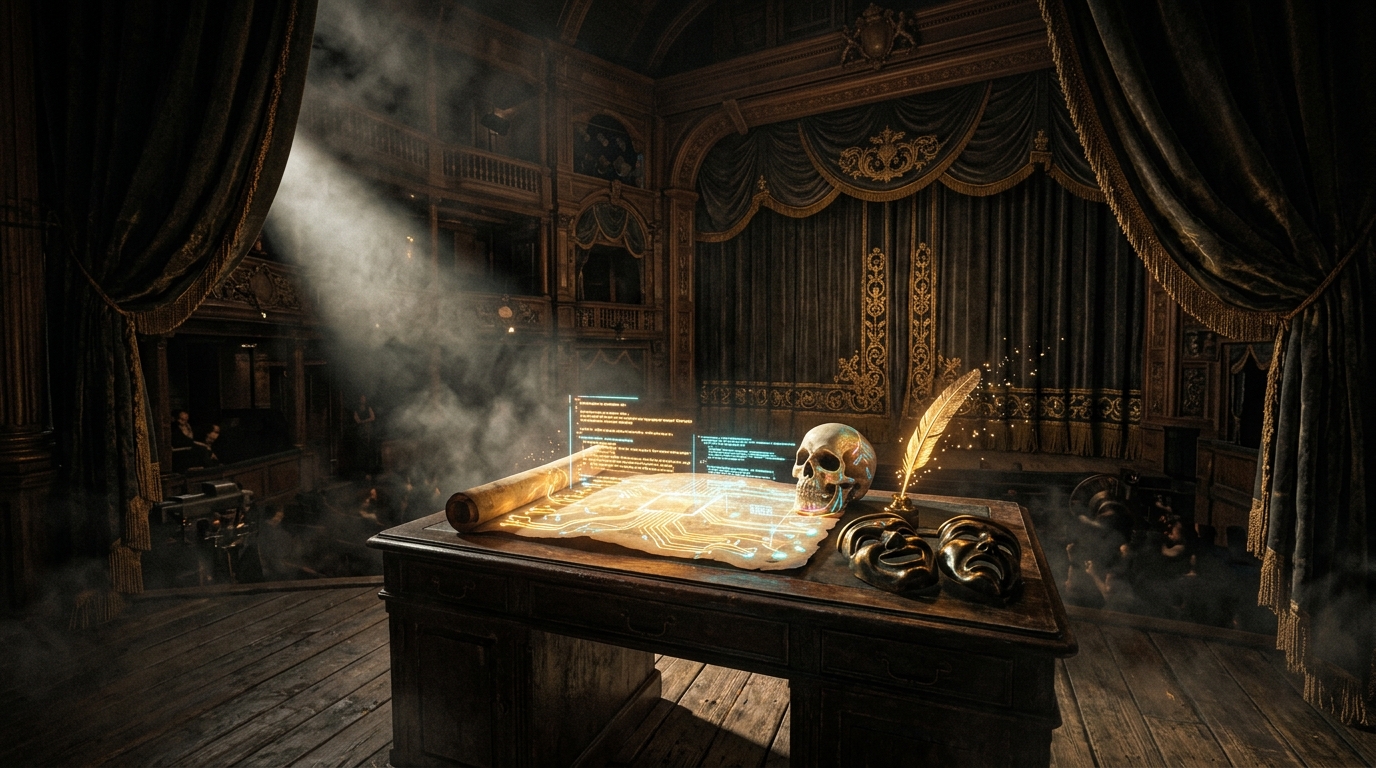
Most programming languages ask you to think like a machine—balancing syntax, strict types, and cryptic symbols. Shakespeare Programming Language (SPL), however, asks you to step into the shoes of a playwright. Here, source code morphs into theatrical scripts, turning ordinary routines into dramatic performances.
Created in 2001 by Jon Åslund and Karl Hasselström, SPL is one of the most famous esoteric programming languages (esolangs). Instead of traditional syntax, an SPL program is structured complete with a cast list, acts, scenes, entrances, exits, and poetic dialogue. The theatrical structure is far from mere decoration—it is the direct mechanism by which you issue instructions to the execution engine.
Dramatis Personae: Characters as Computation
In SPL, characters on stage act as named variables and storage locations capable of holding numeric values. Their insults and compliments alter each other's computational state, while stage directions strictly manage context: characters entering or leaving the stage determine which variables are currently in scope. Spoken questions function as conditional checks, and jumping to specific acts or scenes creates control flow loops.
The Tragedy of Bitwise Arithmetic.

Romeo, a young man of remarkable arithmetic.
Juliet, a maiden whose value exceeds comparison.
Hamlet, a prince pondering stack boundaries.

                    Act I: The Assignment.
                Scene I: Romeo Speaks to Juliet.

[Enter Romeo and Juliet]

Romeo:
  Thou art as sweet as the sum of a gentle summer and a noble king!

Juliet:
  Speak thy mind!

[Exit Juliet]
Even fundamental input and output operations receive a literary makeover. Commands like "Speak your mind" output a character as text, whereas "Open your heart" outputs numerical data. The outcome is source code that reads like an ornate Elizabethan play—where every poetic line doubles as an instruction for the CPU.
The Anatomy of Theatrical Execution
| Theatrical Construct | Classical Programming Counterpart | Runtime Mechanism in SPL |
|---|---|---|
| Dramatis Personae | Variable Declarations | Allocates signed integer registers bound to character names |
[Enter Romeo and Juliet] | Scope Resolution | Pushes variables onto the active interaction stack |
[Exit Juliet] / [Exeunt] | Scope Teardown | Pops character variables out of execution context |
| Compliments & Adjectives | Positive Constants (× 2) | Positive adjectives multiply by 2; nouns yield +1 or -1 |
| Insults & Pejoratives | Negative Constants (× 2) | Negative nouns denote -1; foul insults subtract values |
| "Art thou more honest than...?" | Conditional Branch (if / else) | Compares values; sets processor condition flags (CMP) |
| "Let us proceed to Act II" | goto / Loop Iteration | Jump instruction updating instruction pointer to scene label |
| "Remember me" / "Recall..." | PUSH / POP Stack Operations | LIFO call stack storage assigned per character |
The Artistry of Esoteric Code: Built for the Experience
SPL was never designed for commercial software development or building everyday web services. Its real magic lies in the creative challenge: translating core programming concepts—variable assignment, conditional branching, stack operations, and control loops—into expressive, dramatic dialogue. While the code reads poetically on paper, debugging a tragic flaw in your logic can be surprisingly challenging.
That creative tension is central to its design. SPL proves that underlying programming mechanics remain uncompromisingly precise regardless of visual style: beneath the poetic metaphors, the machine still demands absolute syntactic rigor. Academic researchers often highlight SPL as a striking example of the fascinating intersection between natural language, literature, and executable code.
Act II: The Conditional Branch.
                Scene I: The Trial of the Comparator.

Romeo:
  Am I better than the sweetest flower in Verona?

Juliet:
  If so, let us proceed to Scene III.
  If not, thou art as vile as a coward!
Taking the Stage: Running SPL Programs
Can you actually execute an SPL script? Absolutely. Modern implementations and tools exist, including Python-based interpreters equipped with interactive consoles and debugging utilities, as well as C transpilers that convert SPL source trees into native binary executables. Official documentation offers starter scripts and step-by-step guides to help developers run their first theatrical program directly from the command line.
# Running an SPL script using a modern python interpreter
$ python -m spl_interpreter play.spl

# Or transpiling SPL directly into C for native compilation
$ spl2c < play.spl > play.c
$ gcc -O2 play.c -o play
$ ./play
The Broader Takeaway
While you likely won't build production microservices in SPL, exploring it offers a delightful perspective on language design. It serves as a memorable reminder that coding isn't restricted to terse keywords, semicolons, and curly braces—sometimes, logic is simply awaiting its cue on stage.