The Texas AI Super-Build: Data Centers, Terafab, and the Greatest Industrial Project in American History
Something extraordinary is happening on the plains of Texas. In Abilene, El Paso, Grimes County, and Pecos — places better known for cattle, cotton, and oil — the physical foundation of artificial intelligence is being poured in concrete and steel at a pace the world has never seen.
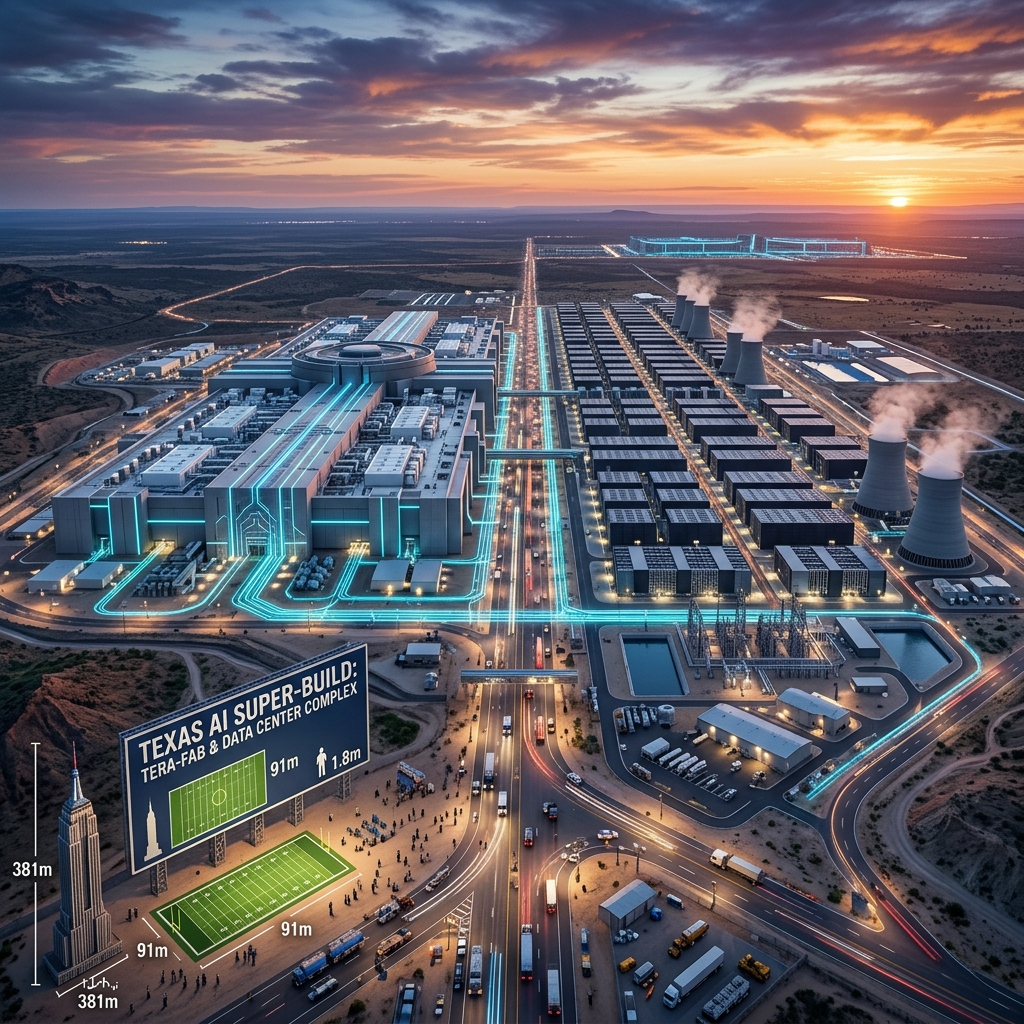
By the end of this decade, Texas will not only host more AI computing power than existed on the entire planet in 2022 — it will also house the factory that builds the brains for everything from self-driving cars to orbital data centers to humanoid robots.
The numbers are so large they strain comprehension. So let's do the math — and then let's talk about what it actually weighs.
---
Part I: The Data Centers — 8.5 Gigawatts of AI Compute
Across Texas, at least seven gigawatt-scale AI data center campuses are under construction or in advanced planning:
| Project | Location | Capacity | Buildings | Square Footage | Investment |
|---|---|---|---|---|---|
| Stargate Abilene (Crusoe/OpenAI/Oracle) | Abilene | 1.2 GW | 8 | ~4 million | ~$32B |
| Crusoe/Microsoft | Abilene | 0.9 GW | 2 | ~2 million | Undisclosed |
| Meta "Project Seafox" | El Paso | 1.0 GW | 12 | 25.9 million | $10B |
| Vantage "Frontier" | Shackelford Co. | 1.4 GW | 10 | 3.7 million | $25B |
| Microsoft/Chevron | Pecos | 2.0 GW | TBD | TBD | Multi-billion |
| Hut 8 "Beacon Point" | Nueces Co. | 1.0 GW | Multi-phase | TBD | $9.8B (Phase 1) |
| Crusoe/Lancium | Childress | 1.0 GW | TBD | 270 acres | TBD |
| TOTAL | ~8.5 GW | ~35M+ sq ft | ~$100B+ |
To put 8.5 gigawatts in perspective: that is roughly the entire electricity consumption of Hong Kong — a city of 7.5 million people — dedicated to running AI models.
---
Part II: Terafab — The Factory That Builds the Brains
But the data centers are only half the story. The other half is Terafab — the most ambitious industrial facility ever conceived.
On August 6, 2026, SpaceX and Tesla made it official: Terafab will be built in Grimes County, Texas, near the Gibbons Creek Reservoir outside College Station. The initial investment is $16.8 billion. The first phase alone is estimated at $55 billion. The full multi-phase buildout could reach $119 billion — making it the most expensive single industrial project in American history.
The Scale
Terafab is designed to be a vertically integrated semiconductor fabrication plant — the first facility on Earth to combine logic chip manufacturing, memory chip production, and advanced packaging all under one roof. The planned footprint:- ◆10 million square meters (110 million square feet) of manufacturing space
- ◆That is 1,000 hectares under roof — roughly the size of a small city
- ◆Larger than Tesla's Gigafactory Texas, Gigafactory Nevada, and Gigafactory Berlin combined — many times over
- ◆The largest building on Earth by floor area
For comparison: the Pentagon is 6.5 million square feet. Terafab will be 17 times larger.
The Power
Musk has stated the full-scale facility will require over 10 gigawatts of power — more than the entire AI data center buildout described above. The site was chosen partly because of the adjacent Gibbons Creek Reservoir (for water) and the availability of land for dedicated power generation.The Purpose
Why build a chip factory larger than anything in human history? Because, in Musk's own words: "We either build the Terafab or we don't have the chips, and we need the chips, so we build the Terafab."The combined demand from Tesla, SpaceX, and xAI is projected to exceed 1 terawatt of compute per year — more than the entire global semiconductor industry is projected to produce by 2030. The chips are needed for Optimus humanoid robots, self-driving Cybercabs, SpaceX's orbital data centers, Starlink satellites, and Grok AI models.
The Partners
In April 2026, Intel joined the Terafab project, contributing its forthcoming 14A process technology (1.4 nanometer). It is a lifeline for Intel's foundry business and a validation of Musk's strategy: if you can't get priority at TSMC, build your own fab with the one American company that knows how. Tesla is building a $3 billion prototype fab at Gigafactory Texas in Austin; SpaceX will lead the full-scale Terafab in Grimes County.The Timeline
- 2026: Prototype fab breaks ground in Austin; Grimes County approves tax abatement - 2027: Prototype fab begins small-batch production of Tesla's AI5 chip - 2028–2030: First phase of Grimes County facility comes online - 2036: Full buildout target across four phasesThe Jobs and the Controversy
Terafab will create at least 3,000 direct permanent jobs and thousands of construction jobs. But at a June 2026 public hearing, more than 100 residents packed the Grimes County Justice & Business Center. Many expressed concerns about the loss of rural character, environmental impacts, and lack of transparency. One county commissioner voted against the tax abatement, saying, "We've surrendered Grimes County values and our quality of life in pursuit of a few dollars." SpaceX will pay $20 million annually to the county for 35 years in lieu of property taxes.---
Part III: What This Actually Weighs
Numbers like "gigawatt" and "billion" slide off the brain. They are too large to feel. So let's talk about something the brain understands: mass. How much physical material does it take to build all of this?
Concrete: 16.4 Million Metric Tons
AI data centers are not light buildings. A standard commercial building might have a 6-inch slab. An AI data center — with racks exceeding 1,000 kW each — requires a 24-to-36-inch reinforced mat foundation, essentially a continuous concrete raft. Terafab, as a semiconductor fab, needs floors that do not vibrate. At all. Ever.16.4 million metric tons of concrete.
That is 2.5 times the concrete in the Three Gorges Dam — the largest dam on Earth. It is five Hoover Dams. It is enough to pave a two-lane highway from New York to Los Angeles and back.
Steel: 1.74 Million Metric Tons
Rebar inside the concrete. Structural steel for the building frames. Roof trusses. Support columns.1.74 million metric tons of steel.
That is 2.5 times the steel in the Golden Gate Bridge. It is roughly 15% of total annual US structural steel production. It is enough to build 17 aircraft carriers.
Copper: 75,000 Metric Tons
Every megawatt of IT power requires massive copper busbars, switchgear, and power distribution units. A single 1 GW data center can contain 5,000–8,000 tons of copper in its electrical infrastructure alone. Terafab adds more.75,000 metric tons of copper.
That is four times the copper in the Statue of Liberty. Enough to wire 350,000 American homes. Roughly 3–4% of total annual US copper consumption.
The Machines: 130,000 Metric Tons
A fully populated Nvidia GB200 NVL72 rack — 72 Blackwell GPUs, networking, liquid cooling — weighs about 1,400 kg. Across the Texas buildout, an estimated 2 million GPUs in 30,000 racks, plus networking, cooling distribution units, and power distribution.130,000 metric tons of IT equipment.
That is roughly the mass of a fully loaded Nimitz-class aircraft carrier — just in servers, GPUs, and racks.
Terafab's Semiconductor Equipment: 160,000 Metric Tons
A single extreme ultraviolet (EUV) lithography tool from ASML weighs 180 metric tons — the size of a school bus. A modern fab might have 10–20 of these. Terafab, at 10 million square meters, is 20–30 times larger than the largest fabs on Earth. Add etch tools, deposition chambers, wafer handlers, clean room infrastructure, and miles of ultra-pure process piping.160,000 metric tons of semiconductor manufacturing equipment.
The Grand Total
| Material | Metric Tons |
|---|---|
| Concrete | 16,400,000 |
| Steel (rebar + structural) | 1,740,000 |
| Copper | 75,000 |
| IT equipment (servers, GPUs, racks) | 130,000 |
| Terafab semiconductor equipment | 160,000 |
| TOTAL | ~18,505,000 |
What Does 18.5 Million Metric Tons Mean?
It is nine D-Days.The entire D-Day invasion of Normandy — the largest amphibious military operation in history, involving 5,000 ships, 11,000 aircraft, and 156,000 troops — moved approximately 2 million metric tons of material across the English Channel over the course of months.
This is nine times that. In concrete and steel and silicon. In Texas. For AI.
- ◆If you loaded it onto standard 40-foot shipping containers, you would need over 710,000 containers. Stacked end to end, they would stretch from Houston to London and most of the way back.
- ◆If you tried to move it all by truck — 20 tons per load — you would need 925,000 truck trips. That is a convoy that, bumper to bumper, would stretch from New York to Los Angeles, then back to New York, then back to Los Angeles again.
- ◆It is the mass of 3,100 Great Pyramids of Giza.
- ◆It is more than the total annual concrete production of France.
- ◆It is equivalent to every person in the United States carrying a 125-pound backpack.
---
Part IV: The Big Picture — Texas as the Silicon Prairie
When you add it all together:
| Category | Total |
|---|---|
| AI Data Center Capacity | ~8.5 GW (and growing) |
| Data Center Investment | ~$100 billion |
| Terafab Chip Fab Investment | $55–119 billion |
| Terafab Manufacturing Space | 10 million sq meters (110M sq ft) |
| Combined Investment | $155–219 billion |
| Combined Power Demand | ~18.5 GW (peak demand of Florida) |
| Combined Material Mass | ~18.5 million metric tons (nine D-Days) |
| Direct Jobs Created | 10,000+ permanent; 25,000+ construction |
The combined power demand — roughly 18.5 gigawatts — exceeds the total generating capacity of most US states. It is approximately the peak electricity demand of Florida. And it is all concentrated in a single state with a standalone grid.
The Geopolitical Dimension
This is not just about commerce. It is about national security.Today, the vast majority of advanced semiconductors are manufactured in Taiwan by TSMC. A single geopolitical crisis in the Taiwan Strait could sever the global supply of AI chips. The Texas buildout represents the United States' answer to that vulnerability. Musk has been explicit: "Building a Terafab was actually also going to be very important to ensure that we are protected against any geopolitical risks."
The Vision: Space-Based AI Compute
Perhaps the most audacious element is the ultimate destination: space.Musk's stated goal is to launch orbital data centers — constellations of AI satellites powered by the sun, free from the land, water, and permitting constraints of Earth. Terafab would produce the radiation-hardened chips needed to operate in that environment.
"The whole point of the Terafab facility is to build chips at such a massive scale that you couldn't possibly put all of the chips that this facility could make into operation on Earth," a SpaceX representative told Grimes County commissioners. "The point is to put the chips on satellites to then do the computing in space."
SpaceX projects launching 1 million tons per year of AI satellites, adding 100 gigawatts of AI compute capacity annually — with no terrestrial power or cooling requirements. The long-term vision includes lunar manufacturing and ultimately 500 to 1,000 terawatts of space-based AI compute.
The Risks
- Financing fragility: OpenAI's cancellation of a 600 MW expansion at its own flagship Abilene campus reveals that demand at this scale is not guaranteed. Nvidia had to step in with a $150 million deposit to backstop the unused capacity. - Grid strain: ERCOT reports more than 200 GW of large loads seeking interconnection to a grid with roughly 85 GW of total generating capacity. The math does not work without massive new generation. - Environmental impact: The gas-heavy power mix raises serious emissions questions. A 2 GW gas plant could emit 8–10 million tons of CO₂ per year. - Community pushback: From Grimes County to Hutto to Pecos, residents are organizing against these projects, citing water, noise, and quality-of-life concerns. - Concentration risk: An extraordinary percentage of global AI compute and chip manufacturing is being concentrated in a single state with a standalone grid. A major hurricane, grid failure, or regulatory shift could have global consequences.---
The Bottom Line
Texas is becoming to artificial intelligence what Saudi Arabia is to oil: the primary source of a critical global resource. By 2030, the state will likely host 10–15 GW of AI data center capacity and the world's largest chip manufacturing facility.
The numbers are almost too large to internalize: $200 billion in combined investment, 145 million square feet under roof, 18.5 gigawatts of power demand, 18.5 million metric tons of material — nine D-Days' worth of concrete, steel, copper, and silicon.
But the most important number may be this one: 12 months. That is how long it took Crusoe to go from breaking ground in Abilene to energizing the first two 100 MW buildings. And Terafab's representatives told Grimes County they are "going to be moving nearly immediately to get going on the project."
The AI age is not coming. It is being built. Right now. In Texas. And it is bigger — and heavier — than anything humanity has ever attempted.