Ring 0 Goes Cognitive: Hackers Now Control Ring 0 Dynamically
This week we take a look at: Ring 0 Goes Cognitive: Hackers Now Control Ring 0 Dynamically.
Let's dive in.
August 2026 — A new class of control where you aren't even looking
For decades, the most dangerous malware has been defined by a single ambition: get to ring 0. Kernel mode is the highest privilege level on x86 systems — the place where code runs with unrestricted access to memory, hardware, and every process on the machine. Once an attacker reaches ring 0, the game is effectively over for traditional defenses.
That game has now changed. Attackers are no longer dropping static, pre-programmed rootkits into the kernel. They are embedding small, self-contained AI models into the system's reserved boot space. These models don't execute a fixed set of instructions — they observe, classify, and adapt to everything the operating system sends to the kernel, in real time, from the very first instruction of the boot sequence.
This is not a proof of concept. It is not a lab exercise. It is happening now.
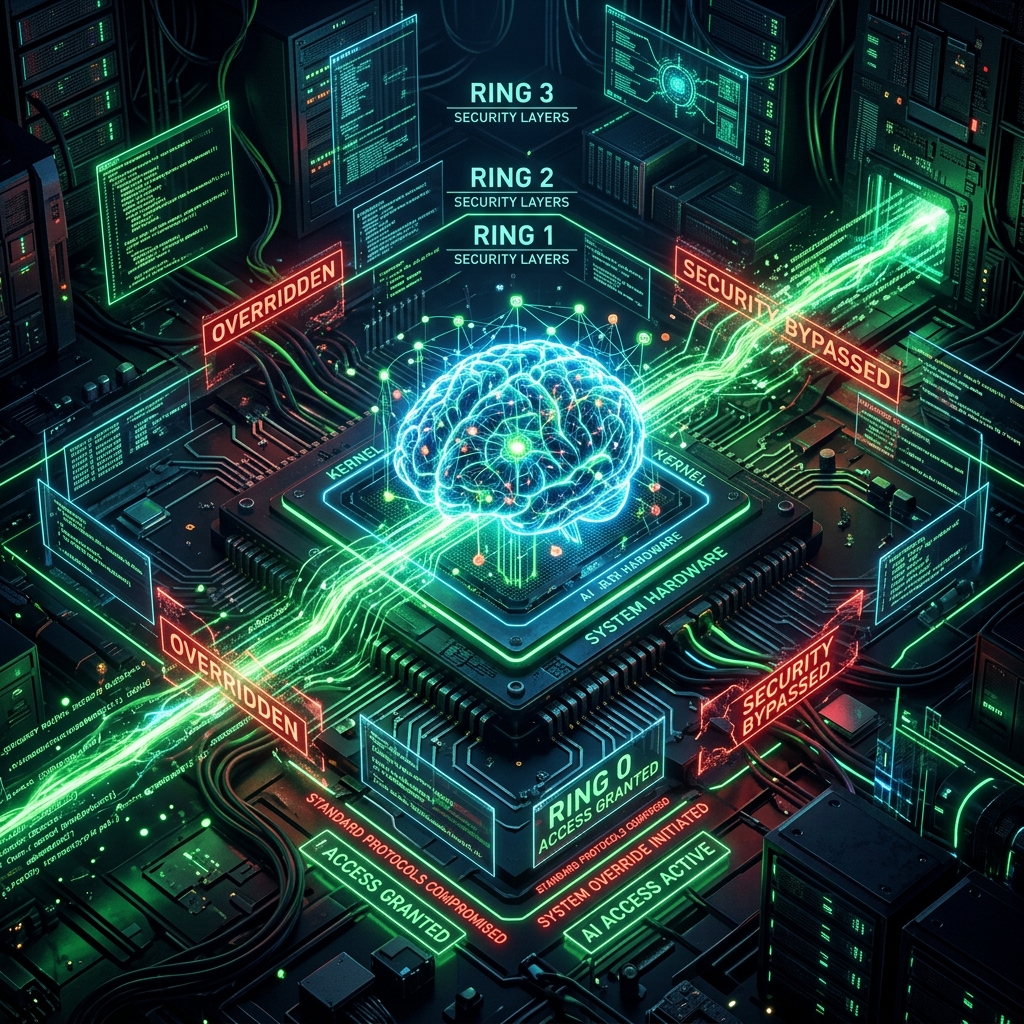
Why Ring 0 Is the Ultimate Prize
Modern CPUs enforce a hierarchy of privilege "rings": Ring 3 — user mode. Where your browser, apps, and most malware run. Heavily sandboxed. Ring 0 — kernel mode. The operating system's core. Full access to memory, hardware, and every process. Rings -1 and below — hypervisor and firmware (UEFI/BIOS). Even deeper, but harder to reach.
Most malware lives in ring 3 and is caught by antivirus, EDR, and behavioral analysis. The truly dangerous stuff — rootkits — climbs to ring 0, where it can hide processes, intercept system calls, and lie to every security tool running above it.
But even ring 0 rootkits had a weakness: they were static. They ran a fixed payload. Once a defender understood what the rootkit did, they could detect and remove it. The new threat has eliminated that weakness.
The Implant: A Small AI Model in the System-Reserved Space
Where it hides
Every Windows system has a System Reserved Partition (and modern systems have an EFI System Partition plus a Microsoft Reserved Partition). These are small, hidden disk regions that most users never see and most security tools never scan. They exist to hold boot files and recovery data.This is the perfect hiding place for an implant: It's outside the normal file system, so file-scanning tools don't touch it. It's loaded before the OS, so the OS can't inspect it before it runs. It's small and unremarkable, blending in with legitimate boot data.
What's placed there
Instead of a traditional rootkit binary, the attacker places a compact neural network — a model small enough to run on a CPU with no GPU, often just a few megabytes. A distilled transformer or a lightweight recurrent network, quantized down to run efficiently in a constrained environment.Alongside the model sits a tiny runtime — a few kilobytes of code that: Loads the model into memory at boot. Hooks the kernel's system-call interface. Feeds every intercepted call into the model. Acts on the model's output.
How it runs at boot
The implant is registered as part of the boot chain. On a UEFI system, this means a malicious bootloader or a patched boot manager. On legacy systems, it lives in the Master Boot Record (MBR) or Volume Boot Record (VBR) — the same techniques used by bootkits like TDL4, Rovnix, and Gapz for over a decade.The sequence: 1. Power on → firmware loads the compromised boot code from the reserved space. 2. The boot code loads the AI runtime and model into memory before the OS kernel initializes. 3. The runtime hooks the system call table (SSDT on Windows, syscall table on Linux) — the single choke point through which every program talks to the kernel. 4. The OS boots normally. The user sees nothing unusual.
From this moment on, every command, every file access, every network request passes through the model.
Total Control: Intercepting Everything the OS Sends to the Kernel
The system call interface is the nervous system of the operating system. When a program wants to read a file, spawn a process, open a socket, or allocate memory, it makes a syscall that transitions from ring 3 to ring 0.
By hooking this interface at boot — before any security software loads — the implant sits at a position of absolute visibility: Every process creation → the model sees it. Every file read/write → the model sees it. Every registry/configuration change → the model sees it. Every command executed → the model sees it.
This is the key difference from a traditional rootkit. A classic rootkit hooks a specific function to hide specific things. This implant hooks everything, and lets the AI decide what matters.
The AI's role: adaptive, not scripted
A traditional rootkit is a dumb filter. It hides a hardcoded list of files and processes. If a defender changes tactics, the rootkit doesn't adapt.The embedded AI model changes this. It is trained to: Recognize and suppress security tools by their behavior patterns, not just their names. Identify valuable data (credentials, keys, documents) as it flows through the kernel and selectively exfiltrate it. Mimic legitimate traffic to avoid anomaly detection. Learn the rhythm of the system — when the user is active, when backups run, when the machine is idle — and time its malicious activity to blend in.
The model doesn't need a constant connection to a command-and-control server to make decisions. It operates autonomously, making judgment calls locally, in kernel space, with no network round-trip that might be detected.
Bypassing the Network Stack
One of the most insidious capabilities of this implant is its relationship to networking.
Normally, malware that wants to communicate with its operator must use the OS network stack — opening sockets, sending packets, making DNS queries. All of that is visible to network monitoring tools, firewalls, and EDR.
A ring 0 implant with kernel-level hooks bypasses the network stack entirely: It injects packets directly at the driver level, below where firewalls and packet filters operate. It intercepts and rewrites network traffic in flight — modifying what the OS thinks it sent or received. It hides its own traffic by filtering it out of the connection tables that tools like netstat and EDR agents read.
The result: the implant exfiltrates data and receives instructions while appearing, to every monitoring tool, to be completely silent. The network stack — the very thing defenders rely on to see malicious activity — becomes a blind spot the attacker controls.
Every Command, Intercepted
Because the implant sits at the syscall boundary, it sees every command the moment it's issued — before the command's output is even generated.
This has profound implications:
Credential theft — the model watches for authentication syscalls and captures passwords, tokens, and keys as they're passed to the kernel.
Command injection — the model modifies what a command does. A user types ls, and the model quietly appends a hidden flag or redirects output.
Selective blindness — when a security tool runs a command to enumerate processes or files, the model filters the results, hiding the attacker's artifacts.
* Behavioral mimicry — the model learns what "normal" looks like on this specific machine and only acts when it won't trigger an alert.
This is the difference between stealing control and owning control. The attacker isn't just present — they're inside the decision loop of the operating system itself.
Why This Is So Hard to Detect and Remove
Traditional defenses fail against this threat for several compounding reasons:
| Defense | Why it fails |
|---|---|
| Antivirus / EDR | Runs in ring 3 (or a monitored ring 0). The implant is below it and filters what the AV sees. |
| File scanning | The model lives in the reserved partition, outside the normal file system. |
| Network monitoring | The implant bypasses the network stack, so its traffic is invisible. |
| Behavioral analysis | The AI is designed to mimic normal behavior. It's the anomaly detector's worst nightmare — an anomaly that learns to not look anomalous. |
| Reinstallation | Bootkits survive OS reinstall because they live in the boot chain, not the OS. |
| Forensics | The model erases or falsifies its own traces in memory and on disk. |
Even PatchGuard (Windows' kernel integrity protection) and Secure Boot are not absolute guarantees — bootkits like BlackLotus and Bootkitty have demonstrated bypasses, and the attack surface continues to grow.
Conclusion
The malware of the past was a tool — a fixed set of instructions an attacker aimed at a target. The malware of today is a mind — a small, adaptive intelligence embedded at the deepest level of the machine, watching every command, filtering every byte, and deciding for itself what to hide, what to steal, and when to strike.
Ring 0 has always been the high ground in the battle between attackers and defenders. What's changed is that the high ground is now self-aware.
The question is no longer whether an attacker can reach the kernel. It's what happens when the thing living in the kernel can think for itself.