A New Era of Reality: A Look at What's To Come in the Reality Space
This week in the Garden Dispatch, we take a look at: A New Era of Reality: A Look at What's To Come in the Reality Space.
Let's dive in.
October 2026 — Spatial Computing & WebXR
Imagine stepping into a digital world in seconds—no massive downloads, no waiting, just an instant leap into a seamless 3D reality right from your browser.
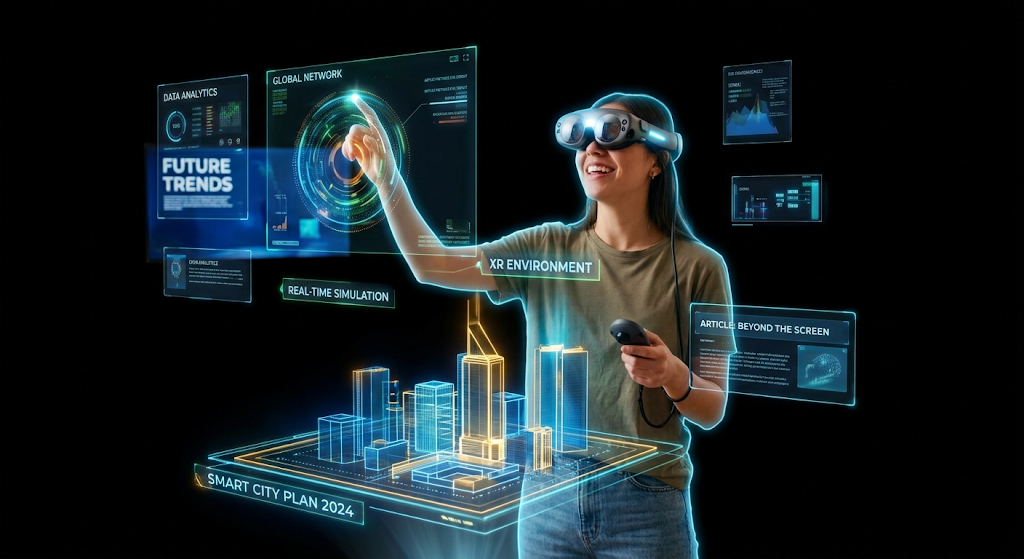
For years, getting someone to experience Virtual Reality (VR) or Augmented Reality (AR) meant overcoming significant friction: buy a dedicated headset, open a platform-specific app store, download a 20-gigabyte game, and wait.
That model is quietly breaking down. The spatial computing industry is shifting toward an approach that mirrors how the rest of the digital world operates: instant, web-accessible experiences powered by the browser and the cloud.
The Two Major Roadblocks Headsets Face
To understand where spatial software is going, look at the physical limits hardware makers wrestle with:
The Weight Problem: A headset is essentially a smartphone strapped to your forehead. If you pack in high-end computer chips, huge cooling fans, and large batteries, it quickly becomes too heavy and uncomfortable to wear for more than 30 minutes. The App Store Barrier: Developers currently have to rebuild the same app multiple times to support different devices (such as Meta Quest, Apple Vision Pro, mobile phones, or emerging smart glasses).
To make headsets lighter, sleeker, and more accessible, the industry has to offload the heavy lifting away from the device itself.
The Solution: WebXR and Cloud Streaming
Instead of requiring users to download massive native apps, modern spatial applications are moving toward two core ideas:
1. Click a Link, Enter a World (WebXR)
Just as web browsers evolved from rendering plain text to running complex software like Google Docs and Figma, they can now render full 3D interactive spaces directly through the browser using a standard called WebXR.
No Installs: A user puts on a headset, taps a web link, and is instantly standing inside a virtual showroom, interactive classroom, or 3D workspace. Write Once, Run Anywhere: Teams can build an experience once using standard web technologies (like JavaScript and Three.js), and it runs on headsets, laptops, tablets, and phones without needing separate app store approvals.
2. Let the Cloud Do the Heavy Lifting
If a scene requires photorealistic detail—like a full architectural walkthrough or an intricate 3D model—the headset doesn't have to calculate every shadow and pixel locally.
Instead, high-powered cloud servers render the complex visual details and stream the video feed to the headset over high-speed Wi-Fi or 5G. The headset only has to track your head and hand movements, keeping the device cool, quiet, and lightweight.
Comparison: Traditional VR vs. The Web-First Approach
| Feature | Traditional Native XR | Web-First / Cloud XR |
|---|---|---|
| Access Method | App Store download | Web URL / QR code scan |
| Storage Required | Gigabytes per application | Minimal (temporary browser cache) |
| Platform Lock-in | High (tied to one ecosystem) | Low (open web standards) |
| Friction to Try | High (downloads & updates) | Instant (click and load) |
| Hardware Strain | High heat and battery drain | Low (offloaded to cloud/efficient web runtimes) |
Conclusion
As browser capabilities expand and cloud infrastructure matures, the friction that once held spatial computing back is rapidly disappearing. By breaking free from isolated app stores and device limitations, WebXR and cloud streaming are laying the groundwork for a truly open, connected, and accessible digital future.