A Savior in the Silicon?
In this week's Garden Dispatch. We take a look under the hood of the memory exploits, that remain built into the very foundation of modern technical infrastructure, from Ring 0 to userland. Lets dive in.
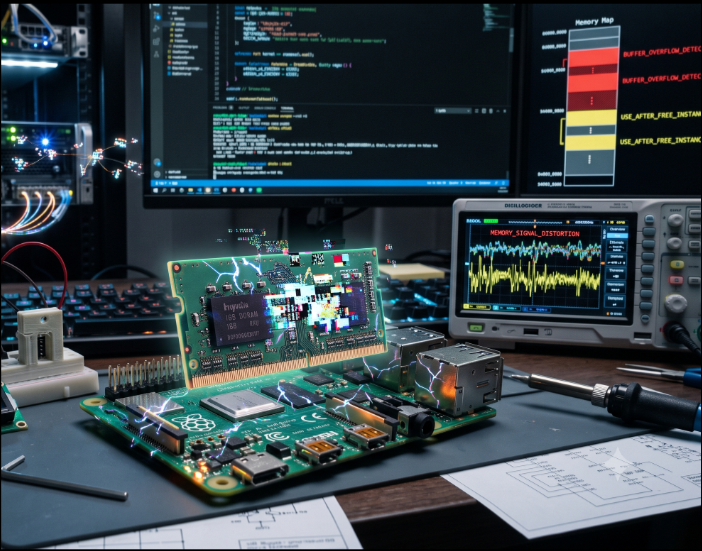
The Pervasive Threat of Memory Corruption
Memory vulnerabilities represent some of the most widespread security issues in modern computing. They currently account for approximately 70% of all critical vulnerabilities in system software written in C and C++. With developers deploying these languages globally in commercial kernel architectures, memory corruption remains a universal security concern.These errors range from spatial memory errors, such as buffer overflows and out-of-bounds array access, to temporal memory errors, like use-after-free and double-free vulnerabilities. The resulting impact includes arbitrary code execution, privilege escalation, and total system failure. These exploits target the core foundation of computing ecosystems: OS kernels, browsers, and hypervisors. Even the AI that we are becoming so dependent on are vulnerable to these attacks Furthermore, hardware-level flaws affect nearly all modern CPUs, requiring frequent microcode and firmware updates to maintain security.
Current Mitigations and Their Limitations
The industry standard has long focused on mitigation rather than elimination. Security professionals advocate for using memory-safe languages like Rust, Java, and Go while enabling and maintaining defenses like:- ◆ASLR (Address Space Layout Randomization): Randomizes memory locations to make targets harder to find.
- ◆DEP (Data Execution Prevention): Prevents code execution from data-only memory segments.
- ◆CFI (Control Flow Integrity): Ensures software follows a predetermined execution path.
However, as hardware and software capabilities advance, these traditional mitigations are being surpassed. While tools like CFI remain strong, they often only mask the underlying problem of memory corruption rather than solving it at the source.
A Savior in the Silicon?
A significant paradigm shift is now occurring: enforcing memory safety directly through hardware protocols. This approach pushes boundary validation and validity tracking into the silicon pipeline itself.Armv8.5-A Memory Tagging Extension (MTE)
MTE implements a hardware "lock and key" paradigm by utilizing unused address bits via Top Byte Ignore (TBI). The system functions through three primary components:- ◆The Key (Pointer Tag): A 4-bit logical tag stored in the upper bits (56-59) of a virtual address pointer.
- ◆The Lock (Allocation Tag): A corresponding 4-bit physical tag stored in dedicated RAM metadata.
- ◆The Enforcement: On every memory access, the hardware compares the key against the lock. A mismatch triggers either a synchronous fault (immediate) or an asynchronous error (accumulated for telemetry).
While MTE provides a 93.75% chance of catching invalid access, it remains a probabilistic defense. Recent research into side-channels demonstrates that speculative execution can still leak tags if they are not properly sandboxed.
CHERI (Capability Hardware Enhanced RISC Instructions)
Developed by SRI International and the University of Cambridge, CHERI offers a deterministic alternative by replacing conventional integer pointers with bounded architectural capabilities.- ◆Expanded Pointers: CHERI expands 64-bit pointers to 128-bit capabilities that include precise memory bounds and permissions.
- ◆Out-of-Band Tag Bit: Extra hardware bits prevent manual bitwise manipulation; if software modifies a capability without proper instructions, the tag clears and renders the pointer invalid.
- ◆Monotonicity: Hardware prevents software from expanding its own bounds, ensuring capabilities only become more restricted over time.
The Path Forward
The industry is slowly moving toward these solutions. Arm MTE is actively deployed in consumer hardware like Google Pixel devices and supports the Android OS and Linux kernel to mitigate heap exploitation at scale. Furthermore, Microsoft’s security analysis suggests that CHERI-style architectures could mitigate over 70% of historical memory vulnerabilities out-of-the-box.There has never been a better time for the tech world to deprecate legacy exploits by halting memory corruption at the hardware level.