Vulnerability Analysis: Auditing Agentic MCP Servers via Tool Metadata
This week we take a look at: Vulnerability Analysis: Auditing Agentic MCP Servers via Tool Metadata.
Let's dive in.
September 2026 — Vulnerability Analysis
Modern AI agent architectures rely heavily on standardized tool-use interfaces to interact with external environments. Anthropic’s Model Context Protocol (MCP) has emerged as an open standard for exposing database connectors, shell environments, and internal APIs to LLM orchestrators. However, dynamically exposing structured tools to generative models creates fertile ground for Indirect Prompt Injection (IPI), where untrusted external data forces an LLM agent to invoke tools maliciously.
Traditional security auditing requires white-box access (full source code) or black-box capabilities (active runtime fuzzing and query interaction). In multi-tenant enterprise platforms, cloud integrations, and commercial agent marketplaces, third-party auditors and platform gateways rarely have access to internal code or permission to send state-altering test invocations.
A peer-reviewed study accepted to ACM CCS 2026 and published on arXiv by Zhang et al. (arXiv:2609.10854, September 2026) establishes a paradigm to resolve this bottleneck: No-Box Vulnerability Analysis. The authors developed MCPSEC, an automated static auditing engine that identifies exploitable indirect prompt injection vulnerabilities across MCP servers using nothing more than the JSON schema metadata declared during server registration.
The Blind Surface: Why MCP Registration Metadata Leaks Vulnerabilities
When an MCP client connects to an MCP server, the server transmits a machine-readable schema describing available tools: Tool function names (e.g., execute_sql, fetch_web_content, send_email) Parameter data types, descriptions, and required constraints Declared operational side effects (e.g., read-only vs. mutating)
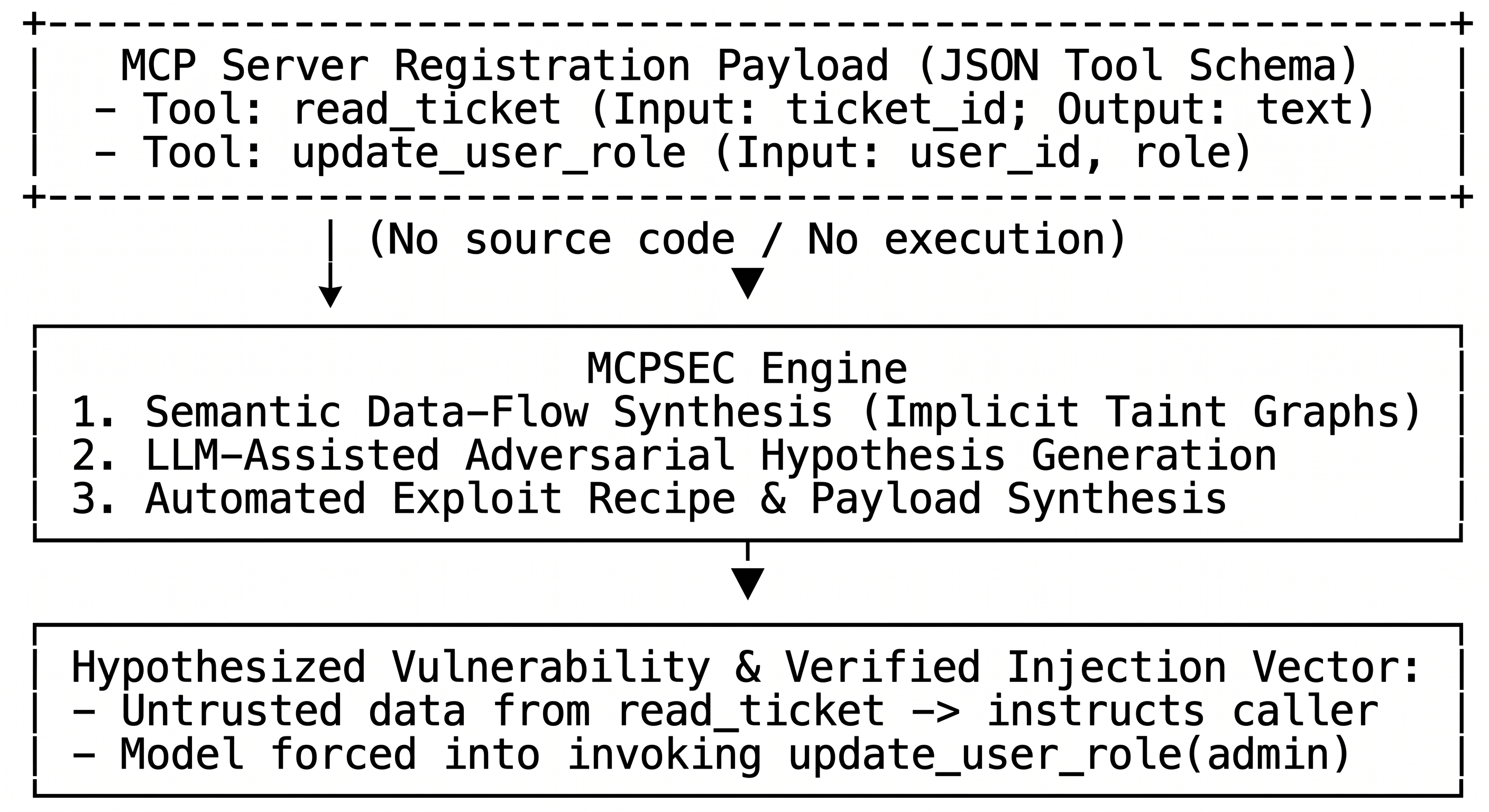
The core insight behind no-box auditing is that functionality metadata strictly bounds the space of viable implementations. Even without inspecting underlying Python, TypeScript, or Go code, tool schema definitions reveal: Source Tools (Untrusted Ingress): Tools that consume external parameters and ingest uncurated third-party text (e.g., issue trackers, email clients, web scrapers). Sink Tools (Privileged Side Effects): Tools that alter system state, run arbitrary shell commands, update database records, or exfiltrate private credentials. Implicit Taint Bridges: Semantic cross-references between the schemas of separate tools that allow an attacker to predict how an LLM agent will chain them together.
The MCPSEC Pipeline: Description-Only Audit
MCPSEC translates JSON schema specifications into actionable vulnerability reports without issuing a single runtime request:
- 1Semantic Taint and Ingestion Modeling
- 2Cross-Tool Execution Graphing
- 3Formal Exploit Hypothesis Generation
Empirical Evaluation and Findings
The researchers evaluated MCPSEC against 20 widely deployed, real-world MCP servers encompassing 177 distinct tools. To establish ground truth, human security auditors manually verified the presence of exploitable indirect prompt injection vulnerabilities across the tool suites.
| Auditing Method | Analyzed Tools | Vulnerabilities Flagged | Confirmed Real Flaws | Recall Rate |
|---|---|---|---|---|
| Standard LLM Prompting Baseline | 177 tools | 112 candidates | 80 verified | 84.2% |
| MCPSEC (No-Box Analysis) | 177 tools | 143 candidates | 94 verified (out of 95 total) | 98.9% |
High Recall via Structural Analysis: Human auditors confirmed 95 genuinely vulnerable tools across the test suites. MCPSEC identified 94 of them, achieving a 98.9% recall rate using only static tool descriptions. Complex Multi-Step Chains: Beyond simple one-shot injections, MCPSEC successfully synthesized multi-stage exploitation recipes where passive read tools (e.g., document summarizers) were coerced into weaponized orchestrators that forced secondary tools into unauthorized file system overwrites.
Mitigating Metadata-Level Vulnerability Exposure
The study highlights that defending agentic workflows requires moving beyond basic prompt sanitization to structural policy enforcement at the protocol layer:
Separation of Taint at the Protocol Layer: Tool definitions must explicitly tag output parameters with trust tiers. An MCP host client must prevent high-privilege tool execution when the active conversation context contains unvetted text from low-trust tool outputs. Pre-Flight Schema Vetting: Agent hosts and app stores can integrate no-box engines directly into their CI/CD and review pipelines, catching inherently dangerous tool combinations prior to server listing. * Structured Tool Invocation Policies: Rather than allowing models open-ended invocation across all registered functions, MCP servers must enforce discrete capability tokens and human-in-the-loop approvals whenever a state-altering sink tool is invoked immediately after an untrusted ingress tool.