The Evolving Threat Landscape: Smart TVs, IoT Botnets, and AI-Driven Deepfakes in 2026
The boundary between consumer electronics, enterprise infrastructure, and criminal enterprise has never been thinner. Three converging threat vectors — compromised smart TVs, weaponized IoT swarms, and AI-synthesized human impersonation — now form an interconnected attack chain that challenges every assumption about perimeter defense. This article examines each vector in technical depth, drawing on the latest research, real-world incidents, and emerging countermeasures as of mid-2026.
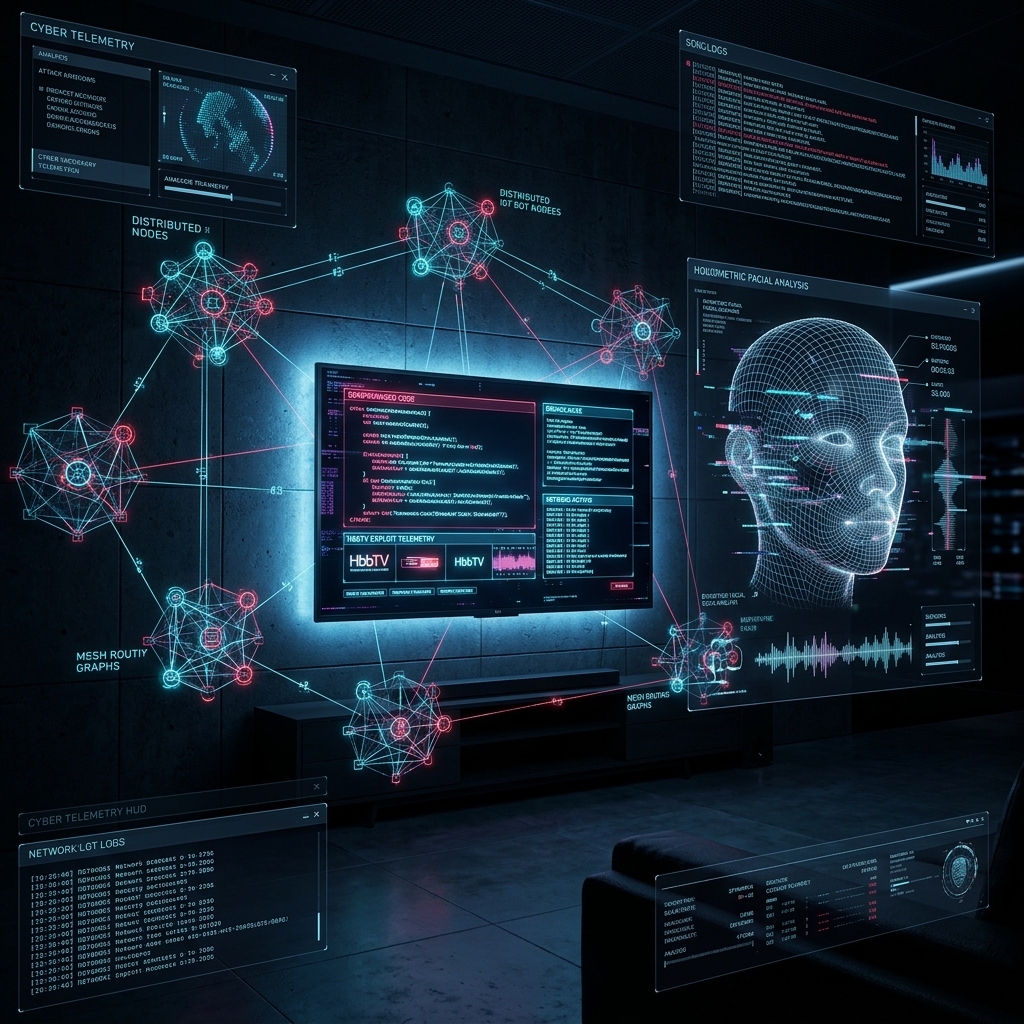
Section 1: Smart TV Exploits & The Living Room Attack Surface
Smart TVs are no longer dumb displays. They are always-on, network-connected Linux or Android endpoints with microphones, cameras, and access to the most trusted segment of a home or enterprise network. They are also, as recent research has demonstrated, catastrophically insecure.
The HbbTV Attack Vector: Broadcast-to-Browser Exploitation
The most significant development in smart TV security this year comes from a landmark study presented at DIMVA 2026 by researchers from Ruhr University Bochum and TU Wien. Their paper, "New Platform, Old Issues: How Web-based TV Broadcasts Threaten Users' Security," represents the first cross-vendor security analysis of HbbTV browsers across Toshiba (Android TV), Samsung (Tizen OS), and LG (WebOS) devices manufactured over the last nine years.
The findings are sobering. The Hybrid Broadcast Broadband TV (HbbTV) standard — deployed across Europe, Oceania, and parts of Asia on millions of devices — allows broadcast streams to carry embedded HTML content that executes inside a built-in browser runtime. The researchers demonstrated that attackers can inject malicious HbbTV applications into broadcast streams and compromise TVs without any user interaction.
The attack surface is threefold:
- 1Denial of Service: All three tested TV platforms could be rendered unusable through malicious HbbTV applications, effectively bricking the device's smart functionality.
- 2Spoofing and Misinformation: Attackers can overlay fake news banners and UI elements onto live broadcasts, replacing legitimate content with convincing forgeries — a vector for mass disinformation that bypasses all traditional content moderation.
- 3Lateral Movement: On Toshiba and LG TVs, the compromised HbbTV browser context grants attackers the ability to send HTTP requests to other devices on the local network. This transforms the TV into a pivot point for attacking higher-value targets: home PCs, NAS devices, and — critically — corporate VPN endpoints when employees work from home.
The researchers released an open-source HbbTV Attack Toolkit (April 2026) that operationalizes these findings. The toolkit, built in Python with a Flask/Socket.IO control server, enables:
- ◆Network scanning from the TV's browser context
- ◆Arbitrary HTTP requests to local and external targets
- ◆Phishing popup injection with credential harvesting
- ◆Channel switching and UI manipulation
- ◆Arbitrary JavaScript evaluation on the target
The root cause is systemic: HbbTV application capabilities are overly permissive, and the embedded browser runtimes on these devices are chronically outdated. The Chromium versions found on tested devices were years behind current releases, carrying known-exploitable vulnerabilities that were patched in desktop browsers long ago.
Local Privilege Escalation: From Browser Context to Root
A separate but equally concerning development emerged in March 2026, when security researchers documented a complete privilege escalation chain on Samsung Tizen-based smart TVs (model UN43T5300). Starting from a compromised browser application context running as an unprivileged user (uid=5001), researchers achieved full root access through a kernel driver vulnerability.
The path is instructive:
The kernel driver /dev/ntksys — part of Samsung's NTK (non-trusted kernel) media stack — was shipped with world-writable permissions (0666). This driver's KER_SYS_IOC_SET_MEM_INFO ioctl accepts a user-supplied physical memory address and size, registers it in a global table, and then — through its mmap path — remaps that physical address directly into the calling process's virtual address space via vk_remap_pfn_range.
The driver performs no validation on whether the requested physical range belongs to kernel memory, whether the caller is authorized, or whether the range overlaps privileged regions. The result is an arbitrary physical memory read/write primitive available to any process on the system.
From there, escalation is mechanical: scan physical RAM for the current task's struct cred, zero out the UID/GID fields, and spawn a root shell. The exploit requires no kernel symbols, no code execution, and no race condition — it is a data-only attack that sidesteps KASLR, PXN, and every other control-flow integrity mitigation.
This is not an isolated incident. The same firmware image exposed multiple NTK device nodes with world-writable permissions (/dev/ntkhdma, /dev/ntkxdma), suggesting a systemic failure in access control design rather than a single engineering oversight.
CVE-2020-28055 and CVE-2020-27403: The Legacy That Persists
The vulnerabilities that first drew attention to smart TV insecurity — CVE-2020-28055 (incorrect permission assignments exposing /data/vendor/upgrade to unprivileged apps) and CVE-2020-27403 (insecure local web servers on port 7989 exposing entire filesystems) — remain relevant in 2026 because the devices that shipped with them are still in service. Smart TVs have replacement cycles measured in years, not months, and manufacturers rarely backport security fixes to models more than two years old.
Defense Strategy for Smart TV Threats
| Layer | Measure | Rationale |
|---|---|---|
| Network | VLAN segmentation with strict ACLs | Isolate smart TVs and IoT devices from primary computing networks. A compromised TV should not be able to reach corporate laptops or NAS devices. |
| Network | Disable UPnP | Universal Plug and Play creates dynamic port-forwarding rules that IoT malware exploits for lateral movement and C2 communication. |
| Network | Egress filtering on IoT VLANs | Restrict outbound connections from IoT segments to only required destinations. Block DoH to unknown resolvers. |
| Device | Disable HbbTV when not needed | If the TV is used purely as a display (e.g., with an Apple TV or Chromecast), disable the built-in smart platform entirely. |
| Device | Force password changes on deployment | Eliminate default credentials — still the #1 OWASP IoT vulnerability. |
| Monitoring | Network-level behavioral analytics | Since EDR agents cannot be installed on smart TVs, deploy network monitoring that baselines normal device behavior and alerts on deviations (e.g., a TV suddenly scanning the local subnet or making outbound connections to unfamiliar IPs). |
| Enterprise | Treat home offices as branch offices | With remote work now permanent for many organizations, the home network is an extension of the corporate attack surface. Provide managed routers with proper segmentation for employees handling sensitive data. |
Section 2: IoT Malware Vectors & The Expanded Perimeter
With IoT devices now exceeding 25 billion globally, they represent the largest unpatchable attack surface in computing history. The malware ecosystem targeting these devices has evolved dramatically since Mirai's source code leak in 2016. The botnets of 2026 are not your 2016 botnets.
Tengu: The Modern Mirai
In July 2026, Nozomi Networks Labs published a deep-dive analysis of Tengu, a Mirai-derived IoT malware family that exemplifies how far the threat has evolved. Tengu is not merely a DDoS tool — it is a full-featured remote access platform.
- ◆C2 Encryption: Tengu uses a custom AEAD (Authenticated Encryption with Associated Data) scheme based on ChaCha20/Poly1305 for server-to-bot commands, with keys embedded in the binary and deobfuscated at runtime via XOR. This is a significant upgrade from Mirai's plaintext C2 protocol.
- ◆Multi-Purpose Payload: Beyond 25 DDoS attack methods (including game-server-specific floods targeting Valve Source Engine, Minecraft, and RakNet protocols), Tengu supports:
- ◆- SOCKS5 proxy functionality — turning compromised IoT devices into relay nodes for anonymizing attacker traffic
- ◆- IPFS payload retrieval — downloading additional malware from IPFS gateways, making takedown harder
- ◆- System and network discovery — exfiltrating interface configurations, ARP tables, and routing information
- ◆- ELF and APK execution — the latter targeting Android-based TV boxes and displays
- ◆Self-Defense: Tengu's anti-removal mechanisms are notably aggressive:
- ◆- A watchdog that disables the hardware watchdog timer, then re-arms it so that if the malware process is killed, the system reboots — turning the watchdog into an anti-remediation device
- ◆- Binary bricking — overwriting ELF headers of reboot, shutdown, and related binaries with
ELFOOD, complicating recovery - ◆- Competitor killing — a continuous loop scanning
/procfor rival malware processes, terminating them viaSIGKILL, and monitoring new process creation through the Linux process connector netlink socket - ◆- Fileless execution via
memfd_create, withargv[0]masquerading as/usr/lib/systemd/systemd-journald
Jackskid: The Android TV Botnet
The most extensively documented botnet of 2026 is Jackskid, reverse-engineered across 80+ samples by the Nokia Deepfield Emergency Response Team and Comcast Threat Research Lab. Their March 2026 report traces Jackskid's evolution from a bare-bones x86 Mirai fork in November 2025 to a sophisticated dual-vector platform with blockchain-based C2.
- ◆Dual Infection Vectors: Jackskid pioneered a two-pronged approach:
- ◆- Telnet brute-forcing (140-200+ credential pairs) targeting IoT cameras, routers, and ONTs — the classic Mirai playbook
- ◆- ADB exploitation of Android TV set-top boxes — a vector first documented by Synthient in the context of the Kimwolf botnet, leveraging permissive residential proxy services to scan internal networks for ADB-exposed devices
The ADB vector is particularly insidious. Attackers route connections through HTTP CONNECT proxies, deploy multi-stage stager scripts that download ELF binaries and APK persistence wrappers, and cycle through package names (com.example.bootsync → com.google.android.gms.update → com.google.play) as each gets flagged by security vendors.
- ◆Triple-Layer Encryption: Jackskid's cryptographic architecture is unusually sophisticated for IoT malware:
- ◆- Layer 1: Custom RC4+LFSR for config obfuscation (key:
DEADBEEF CAFEBABE E0A4CBD6 BADC0DE5) - ◆- Layer 2: XXTEA for key exchange (passphrase:
FrshPckBnnnSplit) - ◆- Layer 3: ChaCha20 for C2 traffic
- ◆Post-Disruption Pivot to Blockchain: After a law enforcement takedown on March 19, 2026, the operator pivoted within days to Ethereum Name Service (ENS) for C2 resolution (
m3rnbvs5d.eth), with C2 IP addresses encoded as obfuscated IPv6 addresses in ENS text records. This mirrors the EtherHiding technique used by the Kimwolf botnet and represents a significant escalation in C2 resilience — blockchain records cannot be seized or sinkholed through traditional DNS takedown procedures.
- ◆Scale: At its peak, Jackskid's fast-flux infrastructure spanned 98+ unique IP addresses across 25+ countries and 30+ autonomous systems, with continuous DNS monitoring revealing 415+ unique addresses over a three-month period.
Nexcorium and Zerobot: The Vulnerability-Driven Campaigns
Two additional campaigns in 2026 highlight the shift toward vulnerability-driven IoT exploitation:
- ◆Nexcorium (April 2026, FortiGuard Labs) exploits
CVE-2024-3721, an OS command injection in TBK DVR devices, to deploy multi-architecture Mirai payloads. It also carries an embedded exploit forCVE-2017-17215(Huawei HG532 routers) — a vulnerability from 2017 that remains exploitable because the devices are still online and unpatched.
- ◆Zerobot (February 2026, Akamai SIRT) broke new ground by targeting not just IoT hardware but the n8n workflow automation platform (
CVE-2025-68613), a tool used by organizations to automate data processing across databases, cloud services, and internal systems. This represents a dangerous expansion of the IoT botnet threat model: compromising automation platforms provides access to the data and credentials flowing through them, enabling lateral movement into enterprise environments.
The Resource Constraint Problem
The fundamental challenge of IoT security remains unchanged: most IoT devices lack the CPU, memory, or storage to run traditional endpoint detection and response (EDR) agents. A typical IP camera or smart plug has a single-core ARM processor running at 600 MHz with 64 MB of RAM — insufficient for even a lightweight antivirus scanner, let alone behavioral analysis.
This means detection must happen at the network layer. Organizations need continuous monitoring that baselines each device's normal communication patterns and alerts when an IoT device deviates — for example, when a smart thermostat suddenly starts making outbound SSH connections or a light bulb begins sending DNS queries for .xyz domains.
Defense Strategy for IoT Botnet Threats
| Layer | Measure | Rationale |
|---|---|---|
| Procurement | Require security disclosures and support commitments from vendors | Devices with published vulnerability disclosure programs and committed support lifetimes reduce long-term risk. |
| Deployment | Force credential resets; disable Telnet | Default credentials remain the primary IoT infection vector. Telnet should be disabled entirely in favor of SSH with key-based authentication. |
| Network | Network-level behavioral analytics | Deploy NTA/NDR solutions that profile IoT device behavior and detect anomalies: unexpected protocols, new destination IPs, traffic volume spikes. |
| Network | Block DoH to unauthorized resolvers | IoT malware increasingly uses DNS-over-HTTPS to bypass DNS monitoring. Force DNS through controlled resolvers. |
| Network | Disable UPnP universally | UPnP is exploited by virtually every IoT botnet for NAT traversal and port opening. |
| Architecture | Zero Trust for device-to-device communication | No IoT device should communicate with another IoT device unless explicitly required. Implement microsegmentation. |
| Response | Have an IoT-specific incident response plan | IoT devices cannot be imaged or forensically analyzed like servers. Plan for network-level containment and physical replacement. |
Section 3: Deepfake Audio & Video Security Threats
If 2024 was the year deepfakes became convincing, 2025-2026 is the year they became weaponized at scale. The technology has crossed a critical threshold: synthetic media is now routinely used to defeat both human judgment and biometric security controls in financially motivated attacks.
The State of the Threat: By the Numbers
The statistics from Singapore tell the story. In January 2025, Singapore recorded 43 deepfake-related cases. In January 2026, that number was over 1,200 — a 28-fold increase in twelve months. One high-profile incident in 2025 saw a Singaporean CFO tricked into transferring US$500,000 during a deepfake Zoom call in which every participant — including the executive's own boss — was fabricated.
This follows the now-infamous early 2024 case in which a finance worker at a multinational firm transferred $25 million after attending a video call populated entirely by deepfaked executives, including the company's CFO.
These are not theoretical scenarios. They are documented, investigated, and confirmed incidents.
Technical Foundations: How Modern Deepfakes Work
Generative Adversarial Networks (GANs) remain the conceptual backbone, but the state of the art has moved decisively toward diffusion models and transformer-based architectures. Modern deepfake generation involves:
- ◆Autoencoder-based face swapping: An encoder compresses source and target faces into a shared latent representation; a decoder trained on the target identity reconstructs the face with the source's expressions and pose.
- ◆Diffusion-based full generation: Models like Sora, Kling, Wan2.1, and Hunyuan can generate entirely synthetic video from text prompts, with no source footage required. These models produce content that is often indistinguishable from real footage to the human eye.
- ◆Neural voice cloning: Voice synthesis models now require as little as ten minutes — and in some cases, mere seconds — of high-quality audio to create convincing real-time voice clones. Audio scraped from social media, earnings calls, webinars, and podcast appearances provides ample training data for targeted attacks.
- ◆Real-time video deepfakes: The Fraunhofer Institute's 2026 research confirmed that real-time deepfake video — convincing enough to fool participants in live videoconferences — is now operationally achievable on consumer-grade hardware.
The Detection Arms Race
The defensive response has accelerated dramatically in 2026. Three major developments stand out:
- 1DeepFakeBuster: Ensemble Detection (August 2026): Published in Scientific Reports, DeepFakeBuster represents a new paradigm in detection: a confidence-calibrated adaptive ensemble that fuses heterogeneous deep learning models, each tuned to detect complementary forensic cues:
The key innovation is reliability-aware adaptive fusion: rather than static averaging, each detector's contribution is dynamically weighted based on its confidence for that specific input. On a dataset of 192,000 authentic and manipulated images, DeepFakeBuster achieved 97.8% accuracy, significantly outperforming both individual detectors and static fusion baselines.
- 2Fraunhofer Real-Time Video Call Detection (August 2026): The Fraunhofer Institute for Secure Information Technology (SIT) in Darmstadt unveiled a prototype that combines audio and video analysis to flag deepfake participants during live videoconferences. The system runs locally on a high-performance laptop — avoiding the privacy implications of sending video feeds to cloud services — and outputs a probability score when multiple warning signs are detected.
The technical challenge is significant: videoconferencing introduces compressed data streams, fluctuating quality, blur filters, and background noise that can obscure the visual artifacts traditional detection methods rely on. Fraunhofer's approach trains on thousands of real and spoofed recordings under simulated videoconference conditions to maintain accuracy despite these degradations.
- 3Omni-Fake and FVBench: Benchmarking at Scale (CVPR 2026): Two landmark benchmarks presented at CVPR 2026 have reshaped the evaluation landscape:
Biometric Defeat and the Authentication Crisis
Traditional biometric authentication — voice recognition, facial matching, liveness detection — is under direct assault. The NTIRE 2026 Robust Deepfake Detection Challenge, with 337 participants and 57 final submissions, specifically tested detectors against degraded, compressed, and adversarially perturbed deepfakes. The results confirmed that even top-performing models degrade significantly under real-world conditions.
This has profound implications for identity verification. Video-based KYC (Know Your Customer) processes, remote identity proofing for financial services, and voice-based authentication for call centers all rely on the assumption that biometric signals cannot be convincingly spoofed. That assumption no longer holds.
Defense Strategy for Deepfake Threats
| Layer | Measure | Rationale |
|---|---|---|
| Process | Out-of-band verification for financial transactions | Any financial transfer or strategic directive requested via voice or video must be verified through a secondary, independent channel — a pre-registered phone number, a secure messaging app, or an in-person confirmation. No single channel is trusted. |
| Process | Challenge-response protocols | During high-stakes calls, require participants to perform unpredictable actions (e.g., "turn your head to the left," "hold up three fingers") that are difficult for real-time deepfake systems to render convincingly. |
| Technology | AI-powered anomaly detection | Deploy defensive AI that analyzes digital media for microscopic artifacts: unnatural blink rates, inconsistent pulse signals in facial blood flow (photoplethysmography), audio frequency anomalies, and lip-sync inconsistencies. |
| Technology | C2PA content provenance | Support the Coalition for Content Provenance and Authenticity (C2PA) standard, which cryptographically signs media at creation with metadata about origin, editing history, and authenticity. |
| Architecture | Zero Trust and granular IAM | Even if an employee is manipulated by a deepfake, their account should lack the privileges to authorize catastrophic actions. Implement just-in-time elevation, multi-person approval workflows, and transaction amount limits. |
| Training | Deepfake literacy programs | Employees in finance, HR, and executive roles must be trained to recognize the possibility of deepfake fraud and to follow verification procedures without exception — even when the request appears to come from the CEO. |
Synthesis: The Convergent Threat Model
These three threat vectors do not exist in isolation. They form an interconnected attack chain:
- 1A compromised smart TV provides a persistent bridgehead on a trusted network segment, invisible to endpoint security tools.
- 2IoT botnet malware — delivered through the same vulnerable consumer devices or through exposed enterprise IoT — provides the distributed infrastructure for large-scale attacks, proxy relay, and credential harvesting.
- 3AI-generated deepfakes exploit the harvested credentials and reconnaissance data to execute highly targeted social engineering attacks against specific individuals, defeating both human judgment and biometric controls.
The common thread is the dissolution of the traditional perimeter. When the attack surface includes every smart TV in every employee's living room, every IP camera in every remote office, and every video call on every executive's calendar, the old model of firewall-and-endpoint defense is no longer sufficient.
The Defense-in-Depth Model for 2026
| Layer | Smart TV Threats | IoT Botnet Threats | Deepfake Threats |
|---|---|---|---|
| Prevent | VLAN segmentation; disable HbbTV; force credential changes | Remove default credentials; disable Telnet/UPnP; patch or replace EoL devices | C2PA provenance; granular IAM; transaction limits |
| Detect | Network behavioral analytics; egress anomaly detection | NTA/NDR profiling; DoH monitoring; fast-flux DNS detection | AI ensemble detection; liveness verification; audio-visual consistency analysis |
| Respond | Quarantine VLAN; physical power-cycle | Network-level containment; block C2 domains/IPs at firewall | Out-of-band verification; challenge-response; freeze affected accounts |
| Recover | Factory reset; firmware update; manufacturer disclosure | Replace compromised device; rotate all network credentials | Post-incident review; update verification procedures; enhance training |
Conclusion
August 2026 finds us at an inflection point. The technologies that make our devices smarter, our networks more connected, and our media more expressive are the same technologies that expand our attack surface. Smart TVs are Linux boxes with microphones that we voluntarily place in our most private spaces. IoT devices outnumber traditional endpoints fifty to one and will never run security agents. AI-generated media has crossed the uncanny valley and now routinely fools both humans and machines.
The defensive response must be equally sophisticated: network-level behavioral analytics where endpoint agents cannot reach, cryptographic content provenance where visual inspection fails, and — above all — process-level verification that does not depend on any single communication channel being trustworthy.
The perimeter is gone. Security in 2026 is about assuming compromise and designing systems that remain resilient even when individual devices, channels, and senses cannot be trusted.