← cd ../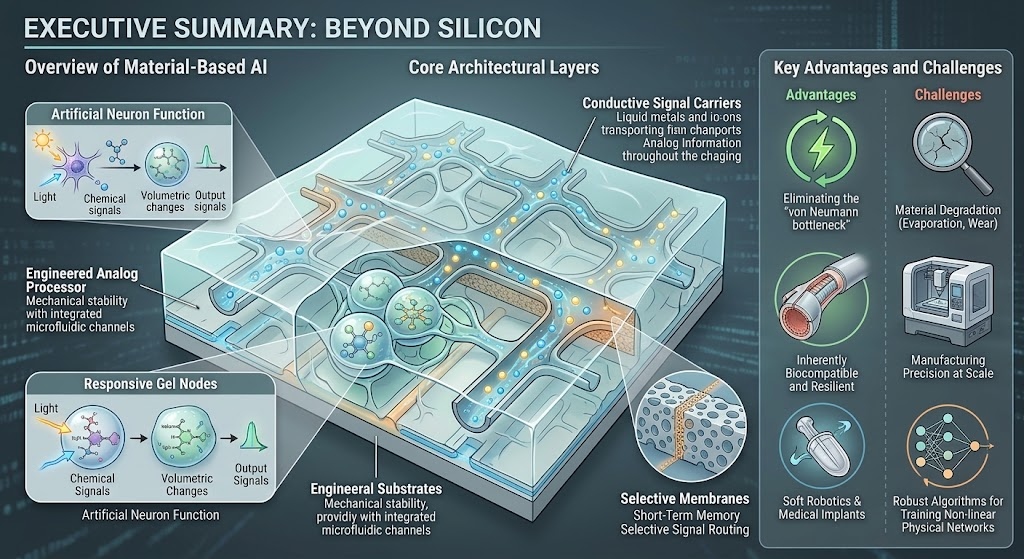
0x09August 24, 2026
Beyond Silicon: The Material-Based AI Revolution
HardwareMaterial-Based AIResearchArchitectureWetware
# Executive Summary: Beyond Silicon
Overview of Material-Based AI
This document explores the emergence of a new AI architecture that moves beyond traditional silicon chips toward systems built from responsive physical materials. By utilizing substrates, gels, liquids, and membranes, these architectures perform computation as an inherent property of their physical state rather than through passive digital switching.Core Architectural Layers
- Structural Substrates: The physical foundation that routes fluids and provides mechanical stability. - Responsive Gel Nodes: Units that function like artificial neurons, changing state (swelling/shrinking) in response to external stimuli to perform nonlinear calculations. - Conductive Signal Carriers: Ions and liquid metals that transport analog information through microfluidic channels. - Selective Membranes: Barriers that control communication between nodes, enabling short-term memory and selective signal routing.Key Advantages and Challenges
Material-based AI offers significant benefits in energy efficiency by eliminating the "von Neumann bottleneck," enabling continuous analog processing that mimics biological efficiency. These systems are inherently biocompatible and resilient, making them ideal for soft robotics, advanced medical implants, and decentralized environmental sensing.However, substantial engineering hurdles remain; addressing material degradation such as evaporation and mechanical wear is critical. Furthermore, achieving the necessary manufacturing precision at scale and developing robust algorithms for training non-linear physical networks are essential prerequisites for widespread industrial adoption.